

Basalt mapping study narrows CO2 storage targets in India’s Deccan Traps
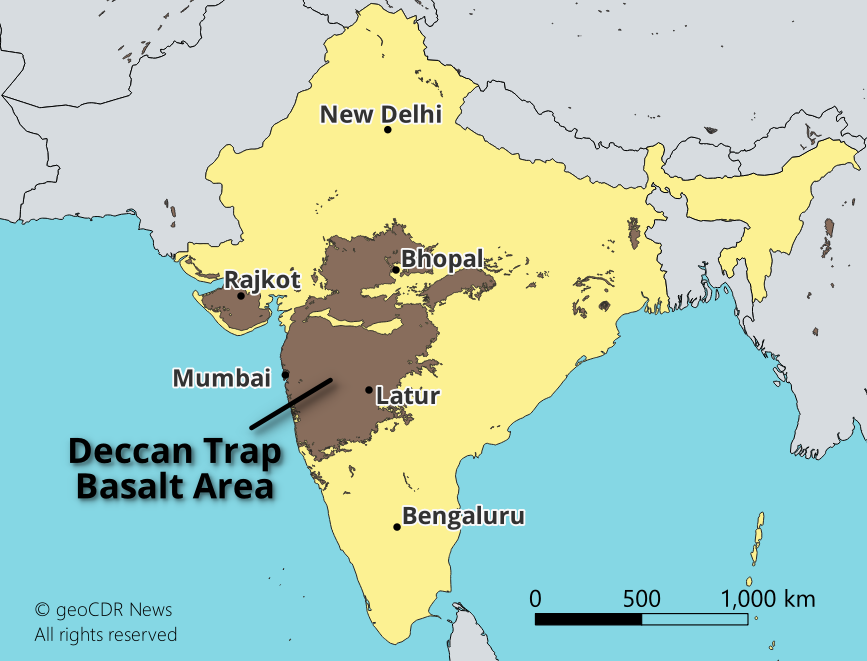
A new identifies priority areas for underground CO2 storage in India’s vast Deccan Traps Province, by screening for several geologic and logistical criteria.
The Deccan basalt weathers out into stair-step like hill slopes, called traps, a word derived from the Swedish word "trappa" which means stairstep.
Researchers used GIS-based decision models—Analytic Hierarchy Process (AHP), Fuzzy AHP, and a Monte Carlo-enhanced variant—to evaluate nine factors affecting where storage projects may work best, including basalt thickness, proximity to CO2 sources, fault distance, and infrastructure access.
The analysis highlights three regions as consistently favorable: the Saurashtra region in Gujarat, parts of northern Madhya Pradesh, and the Mumbai–Pune–Nashik corridor. The regions stand out because they combine thick basalt layers with nearby industrial emissions and existing transportation and energy infrastructure
Across all models, distance from faults emerged as the most critical constraint, reflecting concerns over induced seismicity and leakage risk, while basalt thickness and geothermal gradients were also key drivers of storage suitability.
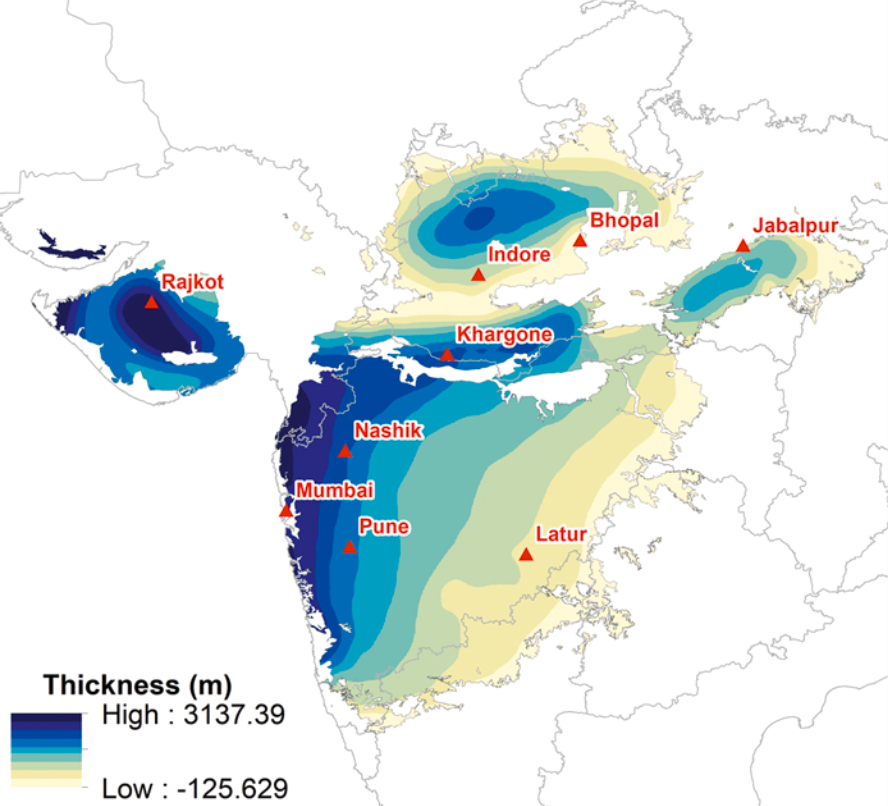
The results suggest that while much of the Deccan Traps is broadly viable, only limited zones meet higher suitability thresholds once safety and logistical factors are included. More conservative modeling reduces the extent of “highly suitable” areas, underscoring uncertainty in early-stage screening.
The study also refines storage potential estimates by incorporating borehole-derived porosity data, reinforcing the region’s capacity for large-scale, long-term CO2 mineralization in basalt formations.
However, the authors caution that site selection remains preliminary. Additional work is needed on geomechanical stability, geochemistry, and seismic risk—particularly in tectonically active zones—before pilot projects can proceed.
The study is among the first attempts to systematically narrow potential CCS locations across the Deccan basalts, with the goal of reducing transport distances and linking storage sites more closely to regional emissions sources.
The findings could help India target future CO2 storage projects closer to major industrial and power-sector emissions sources.