

Ocean alkalinity enhancement may have enormous carbon removal potential—but it remains at the pilot stage
Key points
- Ocean alkalinity enhancement, or OAE, is among the least commercially developed forms of geologic carbon dioxide removal.
- Modeling studies indicate OAE could eventually remove several billion metric tons of carbon dioxide annually.
- The principal barriers to scaling-up OAE include: uncertain removal efficiency, difficult monitoring and verification, possible ecological effects, high infrastructure requirements and incomplete regulation.
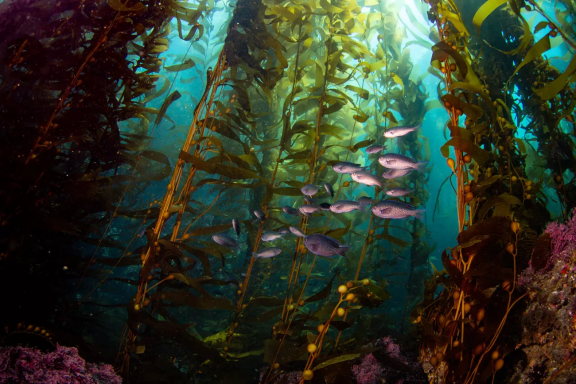
Ocean alkalinity enhancement (OAE) occupies a curious place among carbon dioxide removal technologies. Although many scientists believe it could eventually become one of the world's largest methods of removing carbon dioxide from the atmosphere, it remains one of the least commercially developed. Today, OAE trails both direct air capture with geologic storage and enhanced rock weathering in the number of operating projects and independently verified carbon removals.
The attraction of OAE is the vast size of the ocean and its existing role in the carbon cycle. OAE would increase seawater’s capacity to hold carbon by making the water more alkaline, either by adding alkaline substances or treating ocean water in an industrial process.
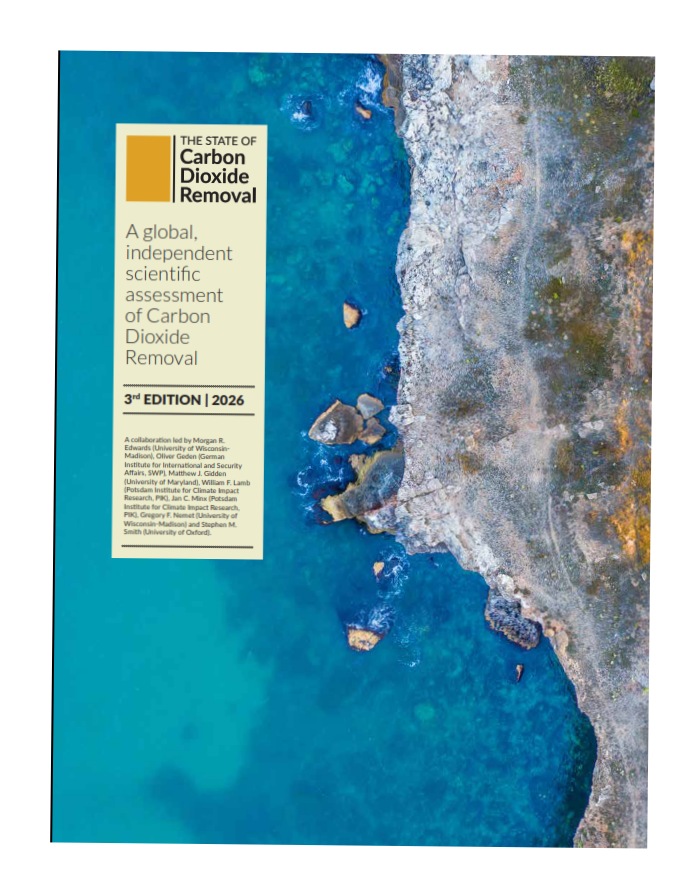
The third (2026) edition of the The State of Carbon Dioxide Removal pegs the carbon removal potential of OAE somewhere between less than 1 and 100 gtCO2 per year (a gt is a gigatonne or 1 billion metric tonnes). This compares to the 1,000 gtCO2 needing removal from the atmosphere within the next century according to the .
The ocean may have the long-term capacity to store of tons of CO2 with limited changes in bulk chemistry.
Despite that enormous theoretical promise, commercial deployment has barely begun. Most OAE work is still taking place in laboratories, computer models, controlled field experiments and a handful of first-of-a-kind pilot plants. Researchers broadly agree that the underlying chemistry is sound. What remains uncertain is how well OAE performs when it moves from scientific studies into the open ocean and eventually to industrial scale.
Jens Hartmann at the University of Hamburg and other researchers summarized the difficulty in a 2023 technical : "The real-world application of OAE, however, remains unclear as most basic assumptions are untested." The researchers said safe and sustainable addition procedures and appropriate governance would be needed before large-scale deployment.
Accelerating a natural geologic process
Ocean alkalinity enhancement is intended to accelerate chemical reactions that already regulate Earth’s climate over geologic time. In nature, rainwater and CO2 mix together to form weak carbonic acid (H2CO3) that weathers rock on land. The rock weathering forms dissolved alkaline compounds like bicarbonate (HCO3-) that eventually reach rivers and the ocean where it remains in solution virtually , thus locking up the carbon that originated from CO2. The key point is that adding alkalinity to the ocean in the form of bicarbonate enables the ocean water to remove more CO2 from the atmosphere.
OAE developers have various strategies for adding alkalinity to the ocean. Some would add to ocean water either finely ground alkaline minerals such as olivine or manufactured alkaline solutions. Others would use electrochemical equipment to separate acidic and alkaline streams from seawater or brine. Still others would process limestone and return a bicarbonate-rich solution to the ocean.
On paper, the chemistry is relatively straightforward. Demonstrating that it works reliably at commercial scale is far more difficult.
How much carbon dioxide is actually removed?
One of the biggest hurdles is determining how much additional atmospheric carbon dioxide enters the ocean because of a project's activities.
Adding alkalinity is not the same as immediately removing an equal quantity of carbon dioxide from the air. Air-sea equilibration can require weeks, months or longer. During that period, treated water may be transported over large distances by currents and mixed vertically in the ocean, making it difficult to detect any effects of the treatment.
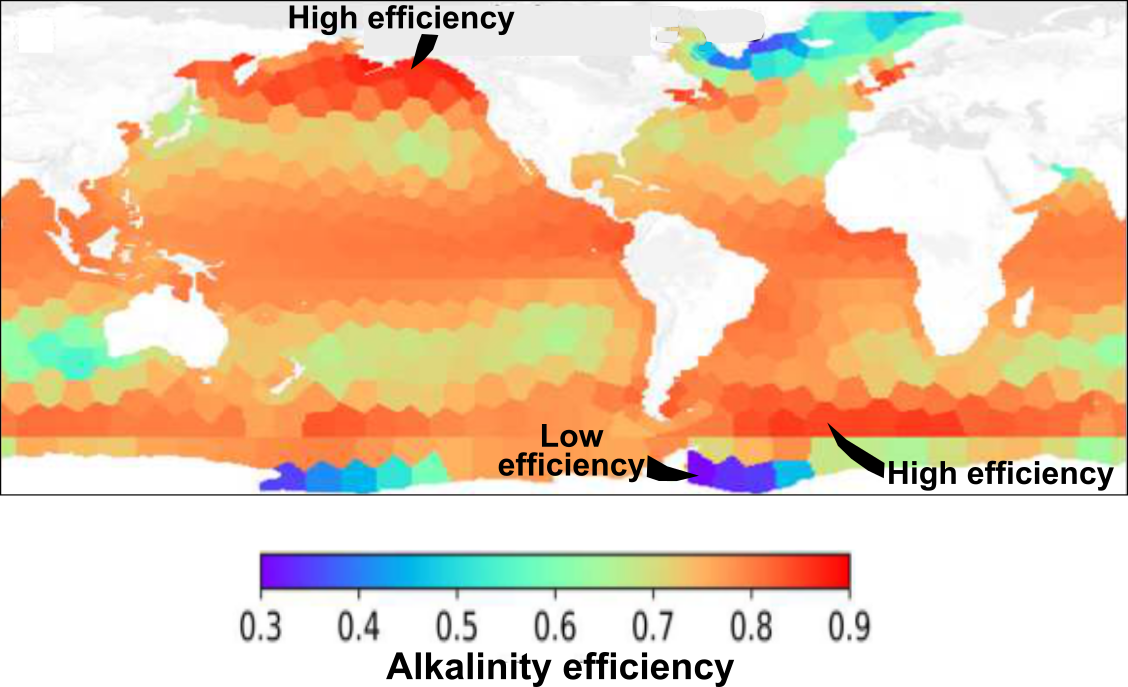
Removal efficiency also varies by location. Some minerals added to ocean water may dissolve only partially. Water temperature, wind, circulation, background chemistry and the rate at which alkalinity is added all affect the result.
A modeling published by a group of workers in 2024 concluded that adding alkalinity to ocean water would be most efficient at increasing ocean uptake of CO2 in the Bering Sea and South Atlantic Ocean (see map below).
Hartmann and his co-authors (mentioned previously), warned that the stability of added alkalinity is central to the durability and efficiency of OAE. A project could add a measured quantity of alkaline material while producing substantially less net carbon removal than a simple chemical calculation would suggest.
Verification is unusually difficult
These uncertainties present challenges for measurement, reporting and verification, commonly called MRV.
A direct air capture plant can measure the carbon dioxide flowing through its equipment, and operators directly measure how much CO2 is injected underground for storage. But an OAE project must make a more complicated claim. It must demonstrate that added alkalinity caused extra carbon dioxide to move from the atmosphere into the ocean, even though the ocean's uptake may occur gradually and far from the point where the alkalinity entered the water.
Developers therefore expect to combine direct measurements using sensors, with ocean-circulation and carbonate-chemistry computer models. They must also account for natural variability, incomplete dissolution of feedstock minerals, secondary precipitation, upstream emissions and leakage of treated water outside the monitored area.
This creates uncertainty for carbon credit buyers. A buyer is not simply paying for alkaline material released or electricity consumed. It is paying for a net metric ton of atmospheric carbon dioxide removal after process emissions and efficiency losses have been deducted.
Environmental questions remain
OAE could produce environmental benefits by counteracting some local effects of ocean acidification. It may also cause undesirable changes if alkalinity is added too quickly, in excessive concentrations or with unsuitable materials.
Researchers are studying possible effects on phytoplankton, zooplankton, shell-forming organisms, microbial communities and marine food webs. Mineral feedstocks can contain nickel, chromium or other trace metals. The environmental significance depends on the material, its concentration, its rate of dissolution and the conditions at the deployment site.
A 2025 of a globally important coccolithophore described the effects of OAE on marine plankton as a “critical knowledge gap.” Researchers have begun developing concentration limits and monitoring approaches, but results from one organism or ecosystem cannot automatically be applied to another.
The need to answer those questions is a major reason present deployments remain small and intensively monitored.
How much will OAE cost?
OAE is often described as one of the lower-cost engineered carbon removal technologies, but no one yet knows what commercial-scale projects will actually cost.
One of the first commercial offtake priced OAE at $272 per ton of CO2 removed. A price under $100 per ton is a long-term target as OAE technology matures.
Costs depend heavily on the technology. Mineral-based systems require mining, grinding, shipping and, in some cases, calcining rock in industrial kilns. Electrochemical approaches avoid much of that mining but instead require large amounts of low-carbon electricity and specialized equipment. In either case, the emissions generated by the process must be deducted to calculate net carbon removal.
Electrochemical systems could avoid some mining and grinding but may require large quantities of low-carbon electricity and costly membranes or processing equipment. A 2026 techno-economic of bipolar-membrane electrodialysis estimated present modeled costs of approximately $1,395 to $2,315 per metric ton, with a potential reduction to about $394 per ton under more favorable technical and economic assumptions.
Pilot projects are beginning to answer key questions
A small group of field projects is now testing different OAE pathways. Some are independent research experiments. Others are company projects supported by advance purchases of future carbon removals. Only a small number have reached credit issuance.
Planetary Technologies
Planetary Technologies has conducted OAE operations at the Tufts Cove generating station in Halifax, Nova Scotia. Its process treats an alkaline mineral product and introduces alkalinity through an existing coastal outfall, where the material is diluted before entering Halifax Harbour.
The project has achieved an important commercial milestone for OAE by creating carbon credits. In June 2025, carbon registry issued 625 independently verified OAE removal credits to be generated at Tufts Cove between 2026 and 2030. The credits were designated for British Airways, Shopify and Stripe. Isometric described them as the first independently verified OAE credits.
Ebb Carbon
Ebb Carbon is developing an electrochemical process that treats seawater or saline water. Its equipment separates the water into acidic and alkaline streams. The alkaline stream can be returned to the ocean, increasing its capacity to absorb carbon dioxide, while the acid must be managed or used in another process.
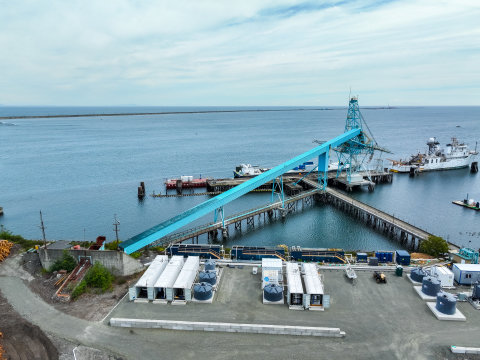
The company has operated demonstration equipment in the western U.S. state of Washington. Ebb Carbon has signed a multiyear advance-purchase agreement with Microsoft.
Ebb Carbon’s approach highlights both the attraction and difficulty of electrochemical OAE. It can produce a controlled alkaline solution without distributing crushed rock directly into the ocean, but its economics depend heavily on electricity, equipment life, acid management and verification of later air-sea carbon uptake.
Equatic
Equatic originated at the University of California, Los Angeles. The company has operated pilot systems in Los Angeles and Singapore. Its electrochemical process removes carbon from seawater while producing alkaline material and hydrogen. The treated water can then absorb additional atmospheric carbon dioxide.
Equatic has announced advance sales, including an agreement associated with Boeing for future removals. As with other early purchases, the contracted quantity should not be confused with independently issued credits already generated by an operating commercial plant.
Equatic also differs somewhat from projects that only add alkalinity. Its process combines seawater electrochemistry, mineral formation and additional atmospheric uptake, making the accounting system boundary and verification method more complex.
Limenet
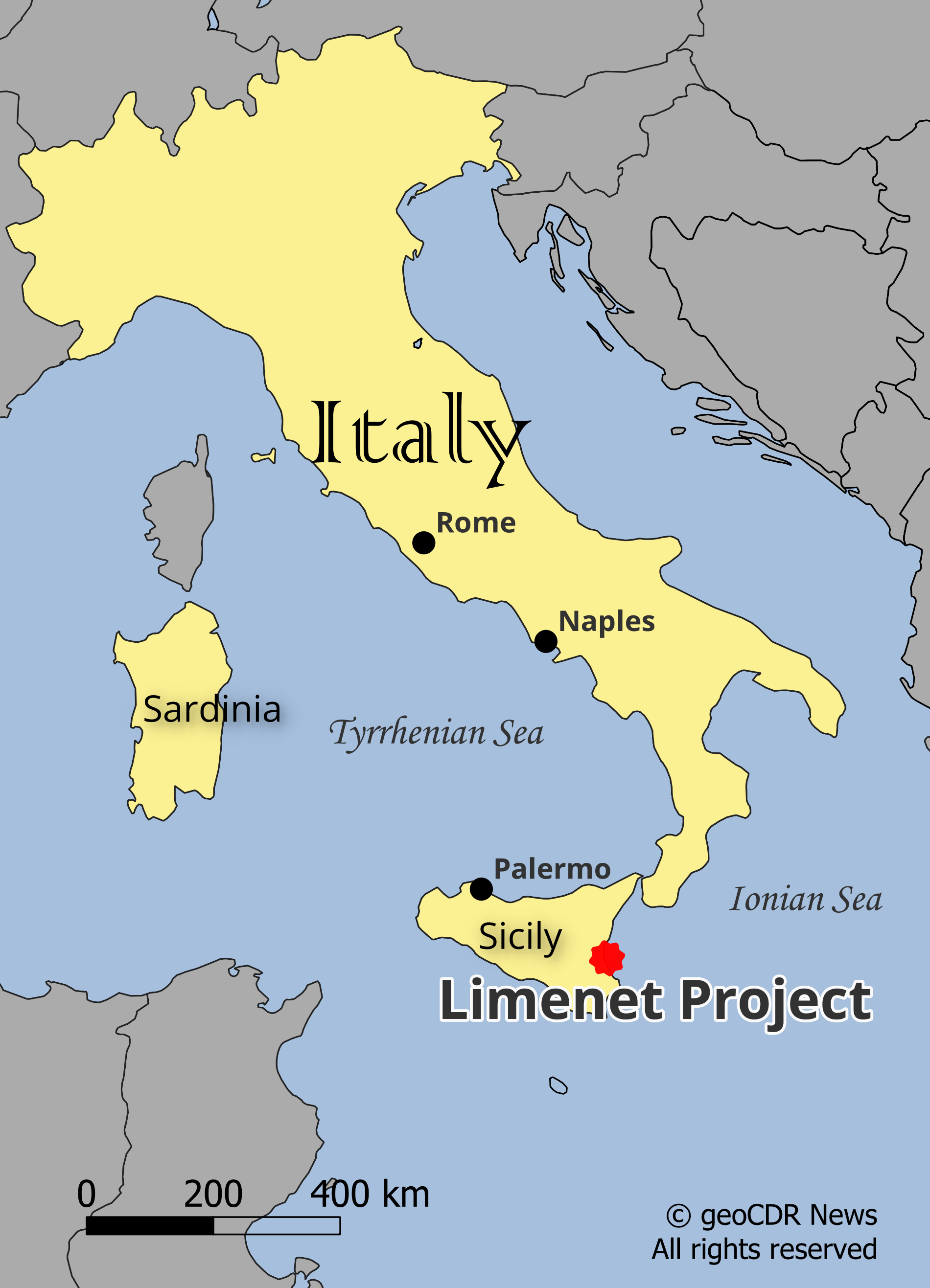
Italian company Limenet is pursuing an approach based on limestone. Its process calcines (heats in a kiln) limestone (calcium carbonate, CaCO3) to produce calcium oxide (CaO) and a concentrated stream of carbon dioxide (which is subsequently captured in the process). The calcium oxide is converted into calcium hydroxide (Ca(OH)2), which is then reacted with carbon dioxide in seawater to produce a calcium-bicarbonate-rich solution.
Limenet says its industrial plant in Augusta, Sicily, is capable of removing approximately 800 metric tons of CO2 a year. The facility follows earlier development work at La Spezia and is intended to demonstrate production of dissolved bicarbonates at industrial scale.
KlimaDAO agreed to purchase an advance on 1,000 metric tons of future Limenet carbon removal. Limenet described the transaction as a sale of carbon-removal certificates intended for resale through the Carbonmark platform. It was a forward commercial agreement, however, rather than evidence that 1,000 independently verified OAE credits had already been issued by a registry.
Limenet’s process is distinctive because it attempts to address the carbon dioxide released during limestone calcination rather than ignoring it. Its net removal will depend on energy emissions, process efficiency, the stability of the resulting bicarbonate and the carbon-accounting rules applied to the system.
LOC-NESS
The LOC-NESS project, led by the Woods Hole Oceanographic Institution and research partners, is a scientific field program rather than a commercial credit project.
In August 2025, researchers conducted the first U.S. Environmental Protection Agency-permitted open-ocean OAE field trial in federal waters in the Gulf of Maine. The team released highly purified sodium hydroxide together with a tracer dye and followed the treated patch with ships, autonomous vehicles, gliders, sensors and satellite observations.
Preliminary results released in February 2026 indicated that the alkalinity patch was successfully dispersed and tracked for about five days. Researchers reported that pH returned to baseline within the expected period, observed dispersal agreed closely with modeling and the treated surface water took up atmospheric carbon dioxide. Preliminary biological measurements found no significant effect on the portions of the biological community examined, although the researchers said broader and longer-term effects require further study.
LOC-NESS has not sold carbon credits. Its importance lies in testing the monitoring methods, models, permitting procedures and ecological measurements that future credit-generating projects may need.
Carbon-credit registries are only beginning to catch up
Carbon markets provide another reminder of how early OAE still is. Carbon-credit registries establish the rules used to determine whether a project has actually removed a measurable amount of carbon dioxide and whether those removals can be sold as carbon credits. Registries also maintain databases that track credits issued under their protocols and later retired when buyers apply them against emissions.
Isometric published an OAE protocol in 2024 and has since published separate protocols for coastal outfalls, electrolytic seawater mineralization and other water alkalinity projects. The protocols establish requirements for all aspects of an OAE project, including: project eligibility, life-cycle emissions, feedstock characterization, alkalinity delivery, environmental safeguards, ocean losses, modeling, uncertainty and third-party verification.
Isometric used the 2024 OAE protocol to issue Planetary’s 625 Tufts Cove credits in 2025 (mentioned above). This made Isometric the first registry shown to have both an operational OAE-specific protocol and credits issued under it.
As of July 2026, no comparably established OAE-specific methodology resulting in issued OAE credits was identified in the public methodology catalogs of Verra, Gold Standard, American Carbon Registry or Puro.earth. Their absence does not imply opposition to OAE. It reflects the difficulty of setting conservative rules for a method in which carbon uptake may occur over large areas and extended periods.
Building an entirely new industry
Even if the remaining scientific questions are answered, developers still face a massive industrial challenge.
Mineral-based approaches will rely on a supply chain of rock quarries, grinding facilities, kilns, ports, ships, storage terminals and coastal distribution systems. Electrochemical systems may require large plants located beside abundant seawater and low-carbon power. Both would need extensive monitoring networks and access to suitable discharge locations.
The scale could be enormous. Removing one billion metric tons of carbon dioxide a year could require handling billions of tons of minerals or seawater-derived process streams, depending on the approach and its efficiency. Transportation emissions, electricity generation and construction materials would have to be included in net-removal calculations.
Projects also face an unusual siting problem. The best location for low-cost minerals or renewable electricity may not be the best oceanographic location for rapid carbon uptake and safe dilution. A commercially successful system must satisfy industrial, environmental and ocean-circulation requirements at the same time.
Regulations remain incomplete
Governments have permitting rules for industrial discharges, marine pollution, scientific research and ocean dumping, but few have comprehensive laws written specifically for commercial marine carbon removal.
Regulators must determine how much alkalinity can be added, what substances are acceptable, how far effects must be monitored and what ecological evidence is required. They must also decide how international ocean rules apply when treated water crosses jurisdictional boundaries.
The LOC-NESS experience (described above) shows that a small scientific test can require extensive technical review, public comment and community engagement. A full-scale project operating continuously would likely face a more demanding process.
Large potential, but evidence must come first
Researchers generally agree that the chemistry behind OAE works. The unanswered questions concern how efficiently different technologies remove atmospheric carbon dioxide, how those removals should be measured and verified, how marine ecosystems respond over decades, and whether the technology can be deployed economically at industrial scale.
The field has begun crossing important thresholds. Alkalinity has been released and tracked in coastal and open-ocean experiments. Pilot plants have been built. Companies have signed advance-purchase agreements. Planetary has generated the first independently verified OAE credits under Isometric’s protocol.
Those achievements are encouraging, but they remain tiny compared with the billions of metric tons of annual carbon removal envisioned by global modeling studies. Before OAE can become a major climate technology, researchers will need to demonstrate reliable performance, robust verification methods, acceptable environmental impacts and economically competitive operating costs.
The likely path to commercialization will therefore be gradual: larger field experiments, longer monitoring periods, standardized environmental safeguards, multiple registry protocols and operating plants that can demonstrate costs rather than merely model them.
Ocean alkalinity enhancement may eventually become one of the world’s largest carbon removal industries. For now, it remains a promising geologic process being translated into an engineered technology — one carefully monitored pilot at a time.