

ZeroEx "upcycling" waste basalt fines in western Germany ERW project
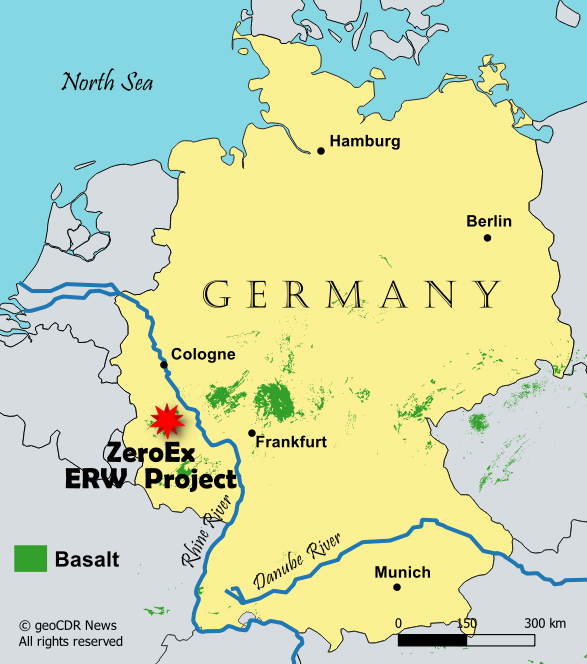
In the rolling farmland of western Germany, a young climate-tech company is testing whether quarry waste rock fines can be turned into a durable climate asset. ZeroEx, a privately held enhanced rock weathering developer founded in the early 2020s, has spread finely ground basalt on cropland in the Eifel region, betting that accelerated weathering of minerals in the basalt powder can remove carbon dioxide while improving soil chemistry. The project name is ZX-24 Vulkaneifel.
Roughly 25% of rock that is mined in an aggregate quarry ends up as fine material during crushing. This fine material (mostly grains less than 5 mm in diameter) is waste that has little commercial value. It commonly is used for backfilling a quarry site's excavated pits. ZeroEx capitalizes on this low-cost waste-stream of basalt fines by redirecting (upcycling) it to enhanced rock weathering operations on farms.
Since the basalt fines are waste that require little additional processing (and emissions) for ERW, their use renders the ERW operation largely carbon-negative. Life-cycle assessments included in the project suggest that emissions from transport, spreading, and monitoring account for roughly 4% of the gross carbon removal, leaving the balance net-negative.
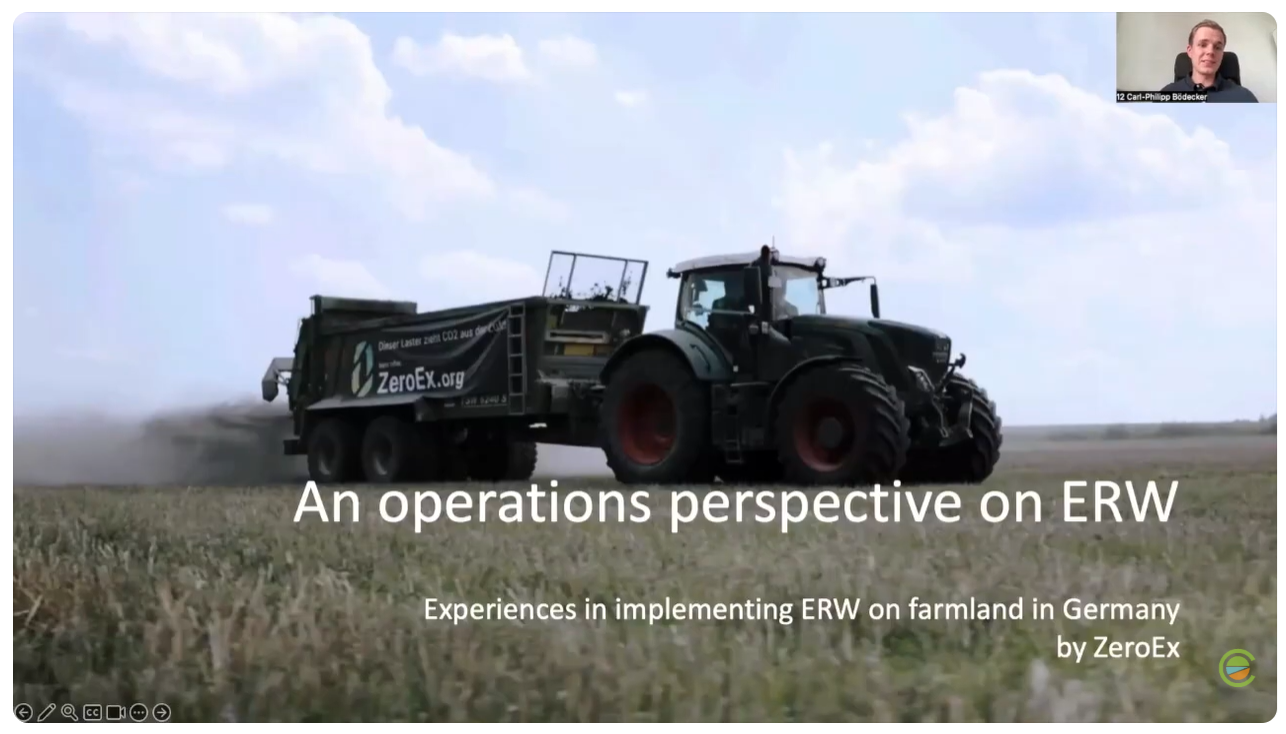
In 2024, the company spread of basalt fines across fields operated by 18 partner farmers, drawing material from four nearby quarries and keeping transport distances below 30 kilometers. The application rate of the fines was about 40 tons per hectare.
Each project unit is typically 500 hectares and each was comprised of three different types of plots: 5% of the unit as a control plot (baseline reference area with no basalt treatment), 5% as a treated plot (densely sampled treated area), and 90% as a deployment plot (treated area with less dense sampling).
Enhanced rock weathering works by accelerating a natural geochemical process: silicate minerals in basalt grains dissolve in mildly acidic soils, releasing calcium and magnesium ions that ultimately bind atmospheric CO2 into stable bicarbonate (HCO3-). Over time, that alkalinity is transported through rivers to the ocean, where it can remain stored for thousands of years.
While the use of waste fines in ERW is notable, what really stands out in ZeroEx's project is its monitoring strategy. Rather than relying solely on periodic measurements of bicarbonate in soil water as an indicator of captured carbon amounts, the company focuses on metal ions such as calcium (Ca2+) and magnesium (Mg2+) that are released from basalt as it weathers. The amounts of these ions are not distorted by biologic processes in the soil, unlike bicarbonate whose carbon atoms may originate from either CO2 in the atmosphere or from biologic processes.
In a farm field, ZeroEx tracks the amounts of calcium and magnesium ions in a "self-integrating accumulator" which is an ion-exchange device — about the size of a large teapot — that is buried in the soil. Calcium and magnesium accumulate in the device, providing a record of the weathering process. The system is supplemented with soil sampling, pore-water analysis, and the use of an immobile tracer such as titanium to distinguish added basalt from native soil minerals.
ZeroEx's monitoring approach is designed to support a ten-year crediting period under the enhanced weathering protocol of the carbon credit registrar Isometric. ZeroEx says the methodology improves accuracy while reducing the cost and labor associated with high-frequency water sampling, a long-standing challenge for agricultural carbon removal projects.
Based solely on the 2024 deployment, the company projects net removals reaching about 537 tons of CO2 in 2025 before declining about 5% per year to 342 tons in 2034.
All of the treated fields drain into the Rhine River, which maintains a relatively high pH (7.8 - 8.0) and ultimately discharges into the North Sea — conditions ZeroEx cites as supportive of long-term carbon storage. Under the Isometric framework, the project is assessed as having a very low risk of reversal.
The economics hinge on carbon finance. Farmers incur no costs and retain the agronomic benefits, while ZeroEx covers feedstock procurement, logistics, spreading, and monitoring in exchange for exclusive rights to the resulting carbon credits. The company is funded through a mix of accelerator support and private capital and operates as a commercial carbon removal developer rather than a farming cooperative or mining venture.
While the German project remains modest in scale, ZeroEx is positioning it as a template. The company says it is also developing enhanced rock weathering projects in Brazil, where large agricultural areas and abundant basalt could support larger deployments.
For a carbon market increasingly focused on durability and measurement credibility, ZeroEx's project in the Eifel region highlights both the promise and the complexity of farming with rocks. Whether quarry fines can be upcycled from the waste pile to a climate solution at scale will depend not just on chemistry, but on whether markets accept metal ions — not just carbon (in carbonate) — as the basis for counting removal.